What is Attestation of Documents? A Complete 2026 Guide for Beginners
If you are preparing to move abroad for employment, higher education, or business, you have likely been asked to submit “attested” certificates. But what is attestation of documents?
Attestation is the formal, legal procedure of verifying the authenticity of a certificate. Because foreign governments and employers cannot directly verify a degree issued by an Indian university or a marriage certificate issued by a local municipality, they rely on a chain of official government stamps. Document attestation is the process of getting those mandatory stamps from state departments, the central government, and the destination country’s embassy, proving your documents are 100% genuine.
Why is Document Attestation Mandatory?
Submitting unverified documents for an international visa application will result in immediate rejection. Foreign entities require attestation for three primary reasons:
Employment:
Companies in the UAE, Saudi Arabia, and Kuwait need proof that your educational qualifications and professional degrees are legitimate before issuing a work permit.
Higher Education:
Foreign universities require attested academic transcripts to grant admission and student visas.
Family Residency:
If you are bringing your spouse or children abroad, dependent visas require legally attested marriage and birth certificates.
The 3 Categories of Documents You Can Attest
The attestation workflow depends entirely on the type of document you hold:
Educational Documents:
Degrees, diplomas, HSC/SSC mark sheets, and transfer certificates. (Requires State HRD verification).
Personal Documents:
Birth certificates, marriage certificates, medical reports, and Police Clearance Certificates (PCC). (Requires State Home Department or SDM verification).
Commercial Documents:
Certificates of Incorporation, export invoices, and Power of Attorney. (Requires Chamber of Commerce verification).
The Standard Embassy Attestation Process
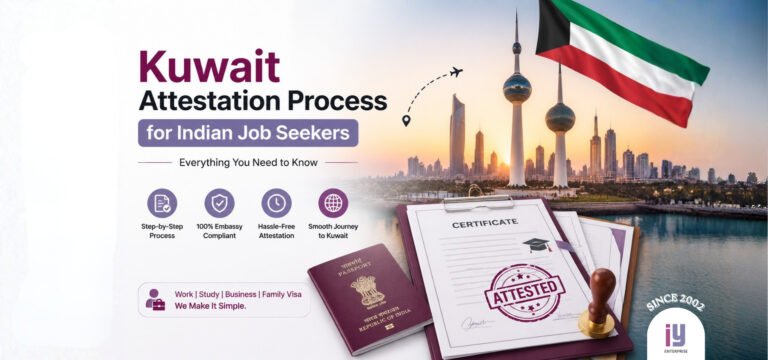
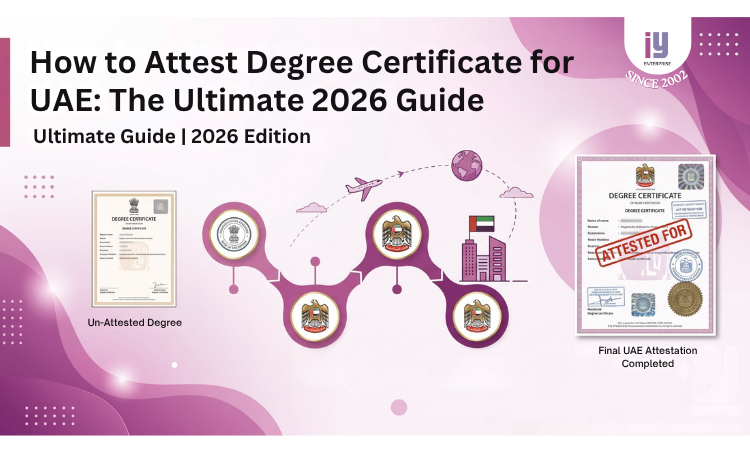
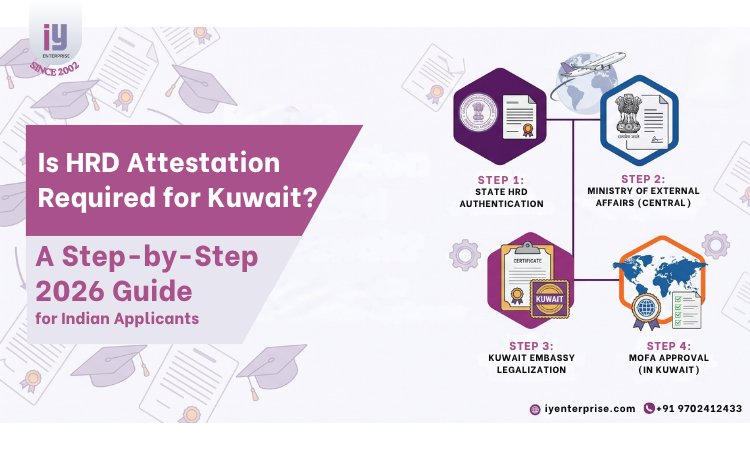
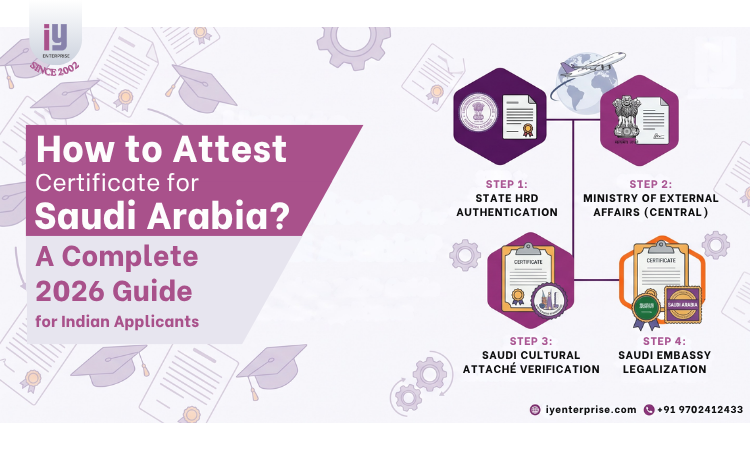
If you are moving to a country that is not part of the Hague Apostille Convention (such as the UAE, Kuwait, Saudi Arabia, or Qatar), your documents must pass through a strict Embassy Legalization chain:
Step 1: Regional/State Verification:
Educational certificates must be verified by the State Human Resource Development (HRD) department, while personal documents go through the State Home Department.
Step 2: Central MEA Authentication:
The document is forwarded to the Ministry of External Affairs (MEA) in New Delhi, which applies the central government seal over the state stamp.
Step 3: Embassy Legalization:
The physical document is finally submitted to the respective foreign embassy (e.g., the Saudi Embassy or Kuwait Embassy in New Delhi) for the ultimate diplomatic stamp.
Note: For countries like South Korea, the final embassy step is skipped, and a single MEA Apostille sticker is sufficient.
Secure Your Attestation with Zero Hassle
Navigating multiple government departments is time-consuming and complex. A single missing seal can delay your visa by months. At IY Enterprise, we manage the entire document attestation and apostille process from start to finish. We offer 100% secure handling, real-time tracking, and fast doorstep delivery across India.
Need expert assistance?
Call: +91 9702412433
Visit: iyenterprise.com
Frequently Asked Questions (FAQs)
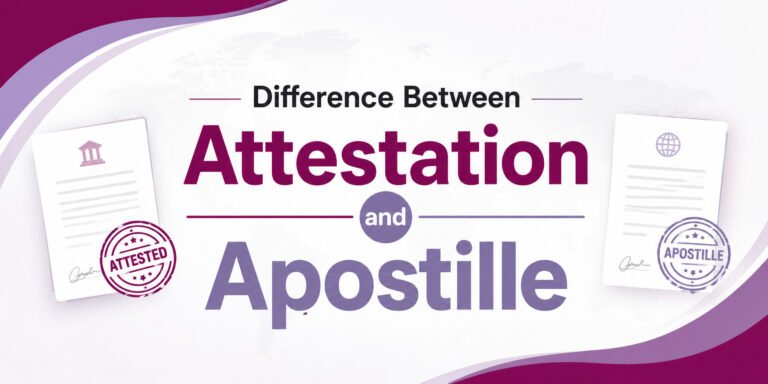
What is the difference between Attestation and Apostille?
While both processes verify the authenticity of a document, they apply to different countries. Attestation is a multi-step legalization process (State, MEA, and Embassy) required for countries that are not part of the Hague Convention, such as the UAE, Saudi Arabia, Qatar, and Kuwait. An Apostille is a simplified, single-step verification (an MEA sticker) accepted by over 120 member countries of the Hague Convention, including South Korea, the USA, and the UK.
Can I do document attestation myself in India?
Yes, but it is a complex and time-consuming procedure. It requires physically traveling to various government offices—such as the State HRD in the state your degree was issued, the MEA in New Delhi, and the respective foreign embassy. A single missing signature or incorrect sequence can lead to visa rejection. Using a professional service like IY Enterprise ensures secure, error-free processing without the hassle of travel and queues.
How long does the document attestation process take?
The timeline depends entirely on the type of document and the destination country’s embassy. Generally, a complete Embassy Attestation process (including State HRD or Home Department verification, MEA authentication, and final Embassy stamping) takes between 15 to 30 working days. State-level verification is typically the longest part of the process.
Is HRD attestation mandatory for all documents?
No. HRD (Human Resource Development) attestation is only mandatory for educational documents (like degrees and diplomas). For personal documents (like birth and marriage certificates), State Home Department or Sub-Divisional Magistrate (SDM) verification is required instead.